When Entrepreneurial Ambition Meets The Right MBA Network
Author: Pola Lem, Executive Editor at Poets&Quants
When Paul Perera returned to the University of Bath for his MBA in 2019, he wasn’t looking for a co-founder. He had already built a career in aerospace engineering and launched a company during the pandemic. The MBA would bring him to grapple with one of aviation’s biggest challenges: decarbonization.
A classmate, Noora Alfaez, would become a key partner in that journey. Originally from the Middle East and living in Malaysia, Alfaez had two degrees under her belt – a bachelor’s in civil engineering and master’s in interior architecture.
Today, the pair are building HyFlux, a company developing hydrogen technologies for aviation and other hard-to-decarbonize industries. They credit not just the skills they gained during the MBA, but the relationships, networks, and sustainability-focused culture at Bath for bringing them together. That and a bit of willingness to take a gamble.
“I took a bit of a risk leaving bigger organizations where I had my career before,” Perera says. “I started to look at entrepreneurship through the lens of how it could have the most impact on society.”
Perera came to entrepreneurship later in his career. Having studied aerospace engineering at Bath in the 1990s, he returned decades later for an MBA. During the pandemic, he founded a company to manufacture protective equipment before pivoting back into aerospace.
“The pandemic and my MBA helped us get a focus on where the business case was, how to build this business and start to raise the finances,” he says.
CONNECTING THROUGH COLLABORATION
Alfaez arrived at Bath with a very different background. Originally from the Middle East, she studied civil engineering before working for six years as a project manager. Later moving to Malaysia, she earned a second degree in interior architecture and launched her own practice before relocating to the UK in 2020 to pursue an MBA.
“I thought going to do an MBA would help me get more experience faster because I would be working with people from different cultures, different nationalities, and different sectors,” she says. “That is exactly what happened.”
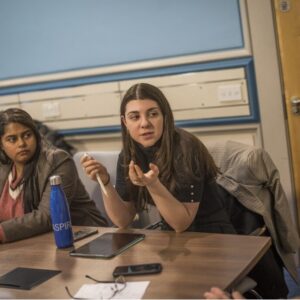
The two first connected through Bath’s MBA projects – real consulting assignments that require students to work collaboratively.
“We always had to be working with teams, brainstorming and discussing,” says Alfaez. “When you start working in groups, you get to know each other better.”
Initially, a similar work ethic brought them together. She says both tend toward the “workaholic” end of things, keeping odd hours.
They also shared an interest in sustainability. Alfaez shared her desire to work on projects to remove plastic pollution from the oceans. Soon, the conversation turned to aerospace – the sector in which Perera was already working.
“We began to talk about projects where we could have a real impact,” Perera adds.
Today, that common purpose remains core to their company.
THINKING BEYOND THE ENGINE
Although HyFlux’s work focuses on hydrogen-powered aviation, Perera says Bath taught him to look beyond individual technologies to think bigger, in terms of entire systems.
One of the MBA’s entrepreneurship modules challenged students to build a startup. At the same time, sustainability courses introduced systems thinking and lifecycle analysis.
“On the sustainability side, the systems engineering thinking really made me think,” notes Perera.
The company is already applying that broader lens to its thinking – an approach that’s already bearing fruit. Perera points to a contract HyFlux recently secured with Bristol Airport.
“We’re thinking beyond our little box of an engine,” Perera says. “How do you get the liquid hydrogen to the airport? How does the airport start looking at cutting the amount of electricity that they might use, or improve the sustainability argument they could take to their local residents?”
He acknowledges that the market for hydrogen is still some years from commercial use – making it hard to secure investors. But Perera is adamant it’s only a matter of time, citing the conflict in the Middle East, which has led to a spike in oil prices; meanwhile, there has been sustained growth in flights since the pandemic.
Even so, he’s thinking about other problems HyFlux can tackle – and fodder for potential future spinouts.
“Whilst we’re building a motor for aerospace, we can turn that motor around and it can be a generator,” he says. “While we’re working on aircraft in the sky, we can solve the problem on the ground as well.”
THE UNIVERSITY RELATIONSHIP BEYOND GRADUATION
Both founders emphasize that graduating from Bath wasn’t the end of their relationship with the university – but the beginning of a different kind of partnership.
HyFlux continues collaborating with researchers at Bath’s Institute for Advanced Automotive Propulsion Systems (IAAPS), while participating in startup incubators, workshops, mentoring schemes, and industry events.
“We’re really working with the University of Bath as much as we can,” Alfaez says.
Some of these relationships have turned into research collaborations.
“We jointly with Bath University wrote a white paper,” says Perera, describing efforts to support hydrogen testing facilities that could benefit both the university and industry.
The founders also continue giving back to the MBA community. “I’ve most recently been back and done some lecturing,” Perera says.
Alfaez mentors current MBA students through Bath’s global mentoring program. She says she’s also in regular contact with faculty. “It is an ongoing relationship,” she says. “You never leave the University of Bath. It’s a life journey.”
BUILDING A GLOBAL NETWORK
For Alfaez, one of the MBA’s greatest strengths was the exposure she got to classmates from around the world.
“I learned from everyone something special,” she says. That international perspective has also given an edge to HyFlux.
Alfaez is leaning on her own cultural insights in bringing the company into new markets. “I understand how South Asia thinks about sustainability. I’m originally from the Middle East. Being between these two worlds and understanding how the UK thinks and how the Middle East thinks has helped,” she says.
Together, she and Perera are now focused on creating a more diverse engineering team. They want to bring more women into the picture.
“We’re encouraging diversity in our team because we don’t have all the answers ourselves,” says Perera. The two have just recruited the engineering lead for their thermal management testing facility.
PLAYING THE LONG GAME
They must also remain focused on the long game; unlike many startup ventures, developing hydrogen technologies doesn’t bring an immediate return on investment.
“This is a 20-year journey,” Perera says. “You need people who want to be really making a difference over a long period of time.”
He admits that deep tech entrepreneurship can be isolating. He is “constantly advocating” for hydrogen fuels on LinkedIn. “I’m having to tackle a lot of the adversity and reaction towards hydrogen because a lot of people think it’s a waste of effort even going into it.”
Especially in face of this uphill battle, Bath’s community has helped sustain that long-term mindset.
“When you’re an entrepreneur, it’s quite lonely,” says Perera. “It’s often about finding not just the people, but the inspiration to keep going…Bath is on is a long-term journey to help get to a more sustainable, resilient economy. And I think that’s a big part of the connection with the university.”
Alfaez echoes the sentiment. “When you move from a different country, you start with zero connections,” she says. “However, [at] the University of Bath, they really support this point.”
She gives credit to the program’s collaborative culture, continuing mentorship, startup incubators, and alumni network – a support system that extends well beyond graduation.
“The whole program is designed to prepare you and give you the most support for a lifetime. You don’t only get the lecture knowledge. You get people knowledge, culture from all over the world, you get connections and your support system for life.”