How An EU Business School MBA Helped This Alumna Build A Big Four Career
Author: Kritsty Bleizeffer, Rankings Editor at Poets&Quants
Zaineh Alabed of Amman, Jordan, has long loved the logic of finance. She studied accounting at Princess Sumaya University for Technology, building a strong foundation in the rules and mechanics of the field.
What she wanted was a better understanding of the decisions behind the numbers. She envisioned a career where she could look at a complex corporate financial statement and understand the business strategy, risk and human judgment reflected in it.
“I realized that if I wanted to level up and really stand out, I needed to bridge my technical accounting background with higher-level financial strategy,” she says.
Alabed decided that if she wanted to land a role at one of the Big Four accounting firms, she needed an MBA that could broaden that technical foundation. She was looking for a global program with a specialization in banking and finance, in a business hub with a dynamic, international culture.
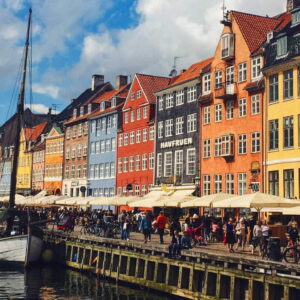
She found both at EU Business School in Barcelona.
WHY BARCELONA? WHY EU?
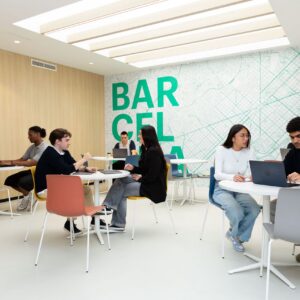
EU’s MBA is a one-year, English-language program offered across Barcelona, Geneva and Munich, as well as through its Digital Campus. Some 92% of its MBA students are international.
For Alabed, Barcelona was part of the calculation from the start.
“Barcelona is an incredible hub that combines strong business connections with a dynamic, international culture,” says Alabed, says Alabed, a 2024 graduate of EU’s Global Banking & Finance MBA. “The structure of the program fit my goals perfectly.”
EU explicitly builds international exposure into its pitch, emphasizing cross-cultural communication, adaptability, global professional connections and the ability to understand how business operates differently across markets.
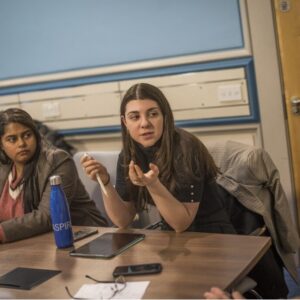
That, for Alabed, was one of the key selling points of the EU MBA. Classmates brought different work habits, communication styles and ideas about leadership. While it made group work more challenging at first, she soon realized it was just the type of learning experience she needed.
“It taught me how to listen better, be patient, articulate my ideas and points clearly without assuming everyone was on the exact same wavelength and remain flexible on how I approach team dynamics,” says Alabed, now Senior External Auditor at Deloitte in Jordan.
“Auditing companies, institutions and banks means working with cross-border teams. Whether I’m collaborating with local engagement teams or aligning with foreign risk managers, my experience in Barcelona removed any hesitation. It made adapting my communication style to different corporate and cultural backgrounds completely second nature.”
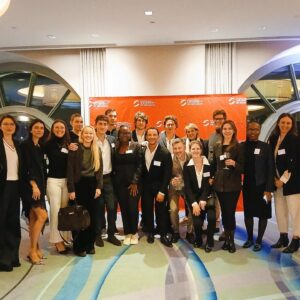
EU Business School reports an alumni network of more than 30,000 graduates worldwide, spread across industries, companies and countries. That community gives graduates access to potential mentors, professional connections and peers navigating many of the same career transitions in markets around the world.
Alabed was able to start building her network well before graduation. Guest speakers, company visits, Career Days and Business Immersion Weeks all brought her and her classmates into contact with professionals working in industries she was exploring.
“The connections you form while solving complex case studies together build strong and lasting friendships,” she says. “Learning from professors with real-world industry backgrounds was a standout part of the program. They brought practical financial insights to life, which gave me tools I still draw on in my work.”
BUILDING A CAREER STORY
EU MBA students have direct access to a Career Services Department designed to help turn their academic and professional experience into a marketable career profile.
Its support spans four broad areas: career guidance and counseling, internship and job-placement assistance, workshops and seminars, and networking events and career fairs. EU’s Career Roadmap takes students from self-awareness and career planning through CV and LinkedIn development, job search, interview preparation, follow-up and contract negotiation.
Advisers also work individually with students on career direction, professional branding and job-search strategy. For Alabed, that meant learning how to translate her accounting background, finance training and international experience into a compelling story for employers.
“The biggest challenge in any competitive market is proving that your degree isn’t just a piece of paper,” Alabed says. “It is demonstrating that your global exposure makes you sharper, faster, and more adaptable under tight deadlines.”
Alabed’s work with EU Career Services helped her articulate her own professional story for the Big Four accounting firms she was targeting.
“Combining a specialized MBA in Global Banking & Finance with a strong accounting foundation gave me a distinct edge,” she says. “It demonstrated to firms that I brought both technical precision and a broad, strategic view of the financial sector.”
OFF THE SPREADSHEET ROI
The MBA return-on-investment calculation, while important for prospective students, starts with the familiar inputs: tuition and lost salary on one side, expected compensation and career advancement on the other.
Alabed measures some of the return differently. For her, the payoff also shows up in how she thinks, works and carries herself professionally.
Her accounting background taught her how to work through a financial statement. Her MBA coursework, built around real-world cases and bank financial statements, pushed her beyond simply reading the numbers to seeing them as signals of a company’s strategy, risk and financial stability.
EU’s MBA leans heavily on applied learning through simulations, company visits, guest speakers and Business Immersion Weeks. Those experiences helped Alabed connect classroom concepts to how executives navigate risk, market shifts and business decisions, giving her practical insights she now applies at Deloitte.
“Auditing isn’t just about verifying line items; it’s about understanding the business behind those line items,” she says.
The return was personal, too. Alabed wanted the MBA to push her outside her comfort zone and build the cultural intelligence needed to work across borders. Living in Barcelona forced her to adapt to different ways of thinking, communicating and solving problems, while showing her that professional ambition can coexist with openness, flexibility and a more grounded approach to work and life.
“The absolute biggest return has been building unshakeable self-confidence alongside a global network of incredible people, and the trust in my own ability to navigate complex scenarios,” she says.
“That mindset shift is the best thing I took away from EU Business School.”
ADVICE FOR PROSPECTIVE MBAS SEEKING GLOBAL CAREERS
One thing Alabed wants prospective international MBA students to understand? A degree can teach finance, strategy and management. But much of the value of studying abroad comes from what happens around the coursework.
“Don’t just hide behind your laptop or lock yourself in the library. The technical material is very important, but the real value is in the people and culture around you,” she says.
“Engage with people, throw yourself into team projects, talk to your classmates, learn about their backgrounds, and embrace the cross-cultural experience. That’s what actually stays with you.”